
You’re probably not here because your cores are working. Maybe a roll came off the winder oval, or a customer sent back film that telescoped on the pallet. The film usually takes the blame, but the problem often starts one layer deeper. Here’s what separates stretch film cores that hold from the ones that quietly cost you. Which one is on your line right now?
What Is a Stretch Film Cores?
It’s the paper tube stretch film is wound on. It holds the roll’s shape, carries its weight, and locks onto the shaft of the winder or the wrapping machine.
- Also called: a pallet wrap core or a stretch film paper tube, depending on who you ask.
- First job: keep the roll round while film is wound under tension.
- Second job: turn with the shaft, not around it, during wrapping.
- Build: layers of paper wound and glued into a rigid tube, then cut to length.
Hand Stretch Film Core vs Machine Stretch Film Core
Both carry the same film, but the rolls are used in very different ways, so the spec shifts with them.
| Hand stretch film core | Machine stretch film core |
| Roll type | Lighter rolls, applied by hand |
| Main stress | Handling, drops, and gripping |
| What matters most | Clean edges and a wall that won’t flatten if dropped |
What Size Core Does Stretch Film Use?
Most stretch film cores come in two inside diameters: 2 inch and 3 inch. Your winder or wrapping machine decides which one, so the size comes from the machine, not the catalog.
| Core size | Inside diameter | Typical use |
| 2″ | 50 mm | Some hand rolls and smaller rolls |
| 3″ | 76 mm | Machine rolls and most hand rolls |
If your line runs machine film, the 3 inch stretch film core is the size you’ll order most.
Core Length by Film Width
Core length follows the width of the film you wind. Get it wrong, and the film either overhangs the core or the core sticks out where it shouldn’t.
- Start from film width: set core length from the exact width of your film.
- Hand rolls: some converters leave the core slightly longer than the film so the roll is easier to hold.
- Machine rolls: length must sit correctly on the machine’s roll holder.
- Order by number: write the length in millimeters, not “standard.”
Core Weight and Net Film Weight
Stretch film is often sold by weight, so the core decides how much of every roll is film and how much is paper.
- Gross weight: film plus core.
- Net weight: film only, which is what your customer pays for.
- Heavy core: less film in a roll of the same gross weight, and more questions from buyers.
- Light core: saves weight but can crush under tension.
- The balance: a pallet wrap core needs a wall thick enough for the tension, and no thicker.
read more :Cardboard Cores for Tape price
Which Specs Keep a Core Round Under Tension?
Three specs decide whether a stretch film core holds up: crush strength, edge quality, and moisture. Each one connects to a problem your operators already know.
Flat Crush Strength vs Winding Tension
Winding tension keeps squeezing the core long after the roll leaves the winder. Flat crush tells you how much of that squeeze the wall can take.
- The rule: higher winding tension needs higher flat crush strength.
- Warning sign: oval cores, or rolls that won’t slide off the shaft.
- What to ask your stretch film core manufacturer: tested flat crush values matched to your winding tension.
Clean, Burr-Free Cut Edges
Stretch film is thin, and it catches on anything rough. A burr at the core’s edge can tear the first layers before the roll is even wound.
- Tears at the start: rough edges snag the film on the first wraps.
- Crooked rolls: uneven cuts make the roll sit at an angle on the shaft.
- Loose fibers: a rough cut leaves paper dust that can stick to the film.
- What to ask: square, clean cuts with no burrs, checked before delivery.
Moisture Control (4 to 7%)
Paper takes moisture from the air, and a core’s strength moves with it. Keeping moisture in a set range keeps the core predictable.
- MAMPACK’s range: core moisture held at 4 to 7 percent under controlled drying.
- Too damp: softer walls, lower crush strength, and an ID that may swell.
- Too dry: edges turn brittle and can crack when cut or loaded.
- Storage: keep cores off the floor and away from open doors in humid weather.
Why Does a Stretch Wrap Core Fail on the Line?
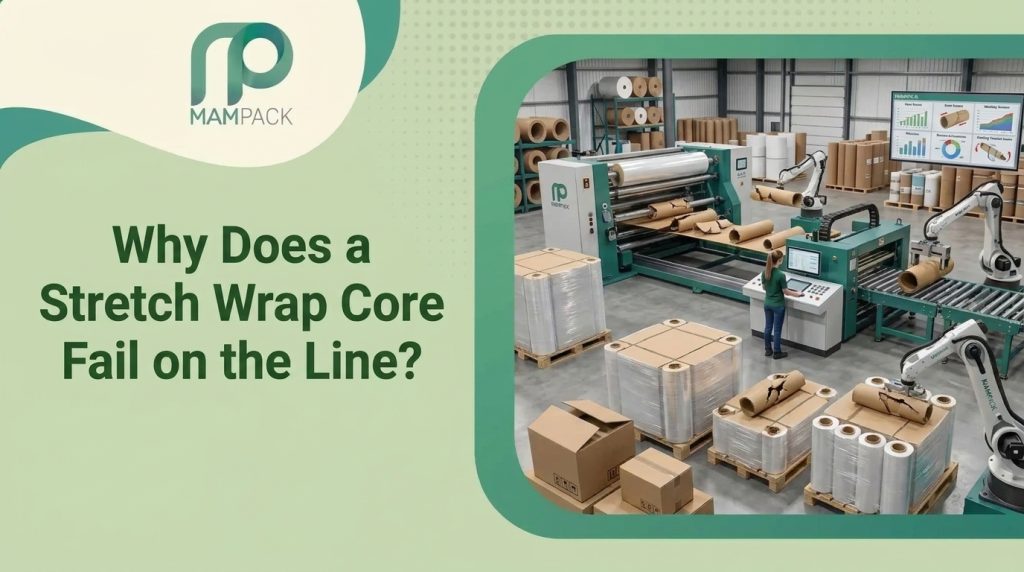
Most line stops blamed on the film actually start with the core. These are the two failures operators see most with stretch film cores.
Core Crushing on the Winder Shaft
The core collapses inward under winding tension, often partway through the roll.
- What you see: oval cores, rolls stuck on the shaft, film wound off-center.
- Main causes: low flat crush, a wall too thin for the tension, or moisture above range.
- The fix: match wall thickness and flat crush to your tension, and check moisture on arrival.
Telescoping and Core Slippage
Telescoping is when film layers slide sideways and the roll turns into a cone. It often starts with a core that slips.
- Slippage: a stretch wrap core with a loose ID turns around the shaft instead of with it.
- The result: uneven tension across the roll, which pushes layers to one side.
- Another cause: crooked cut ends that make the roll sit at an angle.
- The fix: a tight ID tolerance and square cuts on every core.
Why Source Stretch Film Cores From MAMPACK?
MAMPACK is a stretch film core manufacturer in Egypt, making cores since 2015 for film producers who can’t afford a stop mid-run.
- Standard 2 and 3-inch IDs: including the 3 inch stretch film core most machine lines run.
- Wall thickness from 3 to 20 mm: matched to your roll weight and tension.
- Length cut to order: from 1 cm to 10 m.
- Checked before delivery: diameter, thickness, length, flat crush, and edge quality.
- ISO certified for quality management.
- Imported paper from global suppliers for stable quality between batches.
- 1,000+ tons per month of capacity, with 100+ staff and technicians.
- Samples available before supply starts.
Whether you need a standard stretch film paper tube or a heavier wall for bigger rolls, the spec starts from your winder.
read more : Best Cardboard Core Manufacturers mampack
What Should You Send MAMPACK for a Quote?
A precise quote starts with a few numbers from your line:
- Inside diameter: 2 or 3 inch
- Film width and core length
- Wall thickness, or roll weight and winding tension
- Quantity per order
The film gets the attention, but the core decides whether it runs. Send your specs and Request a Quote for stretch film cores that hold their shape from the first wrap to the last.
FAQs
Can stretch film cores be custom length?
Yes, MAMPACK cuts cores to order from 1 cm to 10 m to match your film width.
What size core is used for stretch film?
Stretch film runs on 2-inch (50 mm) or 3-inch (76 mm) inside diameter cores, with 3-inch being the most common on machine lines.
How much does a stretch film core weigh?
It depends on the inside diameter, wall thickness, and length, so the core weight is set when you choose the spec for your roll.
What is the difference between hand and machine stretch film?
Hand film comes in lighter rolls applied by hand, while machine film comes in heavier rolls wound under higher tension for wrapping machines.
Why do stretch film cores crush?
They crush when winding tension is higher than the core’s flat crush strength, often because the wall is too thin or the moisture is above range.