
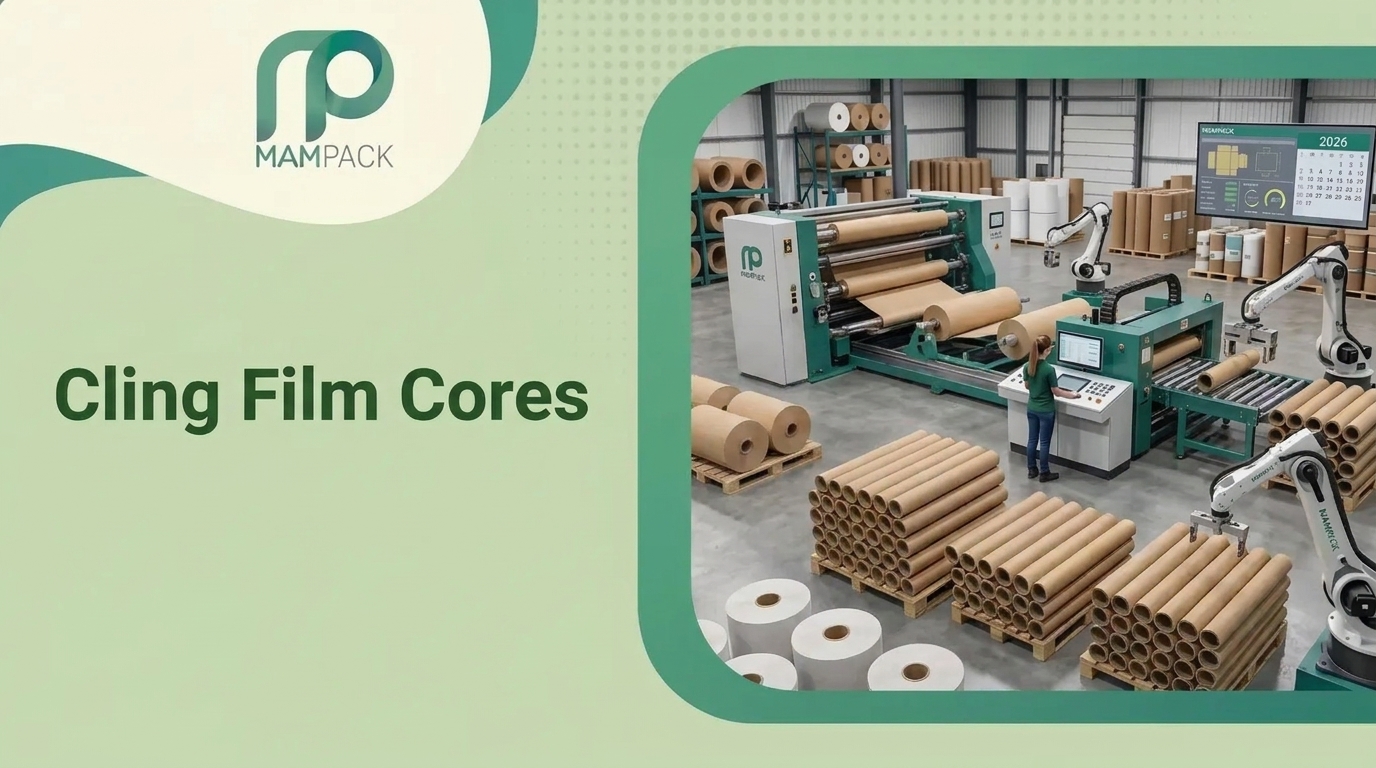
Production and catering rolls usually run on 2-inch (50 mm) or 3-inch (76 mm) cores, while household rolls use smaller custom sizes set by the box and rewinder.
It’s made of layers of paper wound and glued into a rigid tube, then cut to the roll’s length.
Cling film is a thin film for wrapping food, while stretch film is a thicker film used to wrap and secure pallets.
The core doesn’t touch the food directly, but it should have a clean surface and dust-free edges so nothing transfers to the film wound on it.
Yes, MAMPACK makes cores to your drawing, with custom inside diameter, wall thickness, and length.What size core does cling film use?
What is the core of cling film made of?
What is the difference between cling film and stretch film?
Are cling film cores food safe?
Can cling film cores be custom made?
What Is a Cling Film Cores?
It’s the paper tube cling film is wound on, from the large rolls coming off the production line to the small ones that end up in a kitchen drawer.
- Also called: a food wrap core or a cling film paper tube.
- Main job: keep thin film wound evenly so it unrolls without tearing.
- Why it’s different: it sits right under film that touches food, so cleanliness matters more than on most cores.
- Build: layers of paper wound and glued into a rigid tube, then cut to length.
Catering Rolls vs Household Rolls
Same film, two very different rolls. The core changes with who uses the roll and how often.
| Catering cling film core | Household food wrap core |
| Roll size | Wider, heavier rolls for kitchens and food service |
| How it’s used | Pulled many times a day, often from a dispenser |
| Main need | Strength and clean edges under frequent pulling |
What Does a Core Need for Food-Contact Film?
The core doesn’t touch the food, but the film wound on it does. That’s why cling film cores are judged on cleanliness as much as strength.
Clean Surface and Dust-Free Cutting
Paper dust and loose fibers are the main risk here. They come from rough cuts and travel straight into the first layers of film.
- Smooth outer surface: nothing that transfers to the film during winding.
- Clean cut ends: no burrs or loose fibers at the edges.
- Why it matters more here: PVC film is thin and clingy, so a PVC cling film core with a rough edge passes every speck of dust into the roll.
- What to ask: edge quality checked before delivery, plus clean packing so cores arrive the way they left the factory.
Moisture Control and Dimensional Stability
Paper reacts to the air around it. A cling film core that swells or shrinks changes how the film winds and how the finished roll fits its box.
- MAMPACK’s range: moisture held at 4 to 7 percent under controlled drying.
- Too damp: the core softens and the ID can swell, so it may not load on the rewinder.
- Size drift: a core that changes size can leave household rolls loose or jammed in their boxes.
- Storage: keep cores sealed and off the floor, especially in humid months.
Which Core Size Fits Your Cling Film Rolls?
Your rewinder sets the inside diameter, and the roll type sets the length. Here are the core options MAMPACK makes and where each one fits.
| Roll type | Core option | What to check first |
| Production rolls | 3″ (76 mm) standard | Wall strength for the roll weight |
| Catering rolls | 2″ (50 mm) or 3″ (76 mm) standard | ID fit on your rewinder and dispenser |
| Household rolls | Custom ID and length, made to drawing | Fit inside the retail box |
- Wall thickness: from 3 to 20 mm.
- Length: cut to order, from 1 cm to 10 m.
- Dispensers: some catering dispensers hold the roll by its core, so a catering cling film core needs an ID that fits the dispenser too.
- Common mistake: most size problems with cling film cores come from copying an old order instead of measuring the current machine.
How Is a Food Stretch Film Core Different From an Industrial One?
Both carry stretch film, but one wraps sandwiches and the other wraps pallets. That difference changes almost everything the core has to do.
| Food stretch film core | Industrial stretch film core |
| Film | Thin PVC or PE cling film |
| Roll weight | Lighter |
| Winding tension | Lower |
| Top priority | Clean surface and dust-free edges |
A PVC cling film core rarely fails from crushing. It fails from dust, moisture, or a loose fit. For pallet film, see our guide to stretch film cores.
read more :Prevent Stretch Film Core Failure & Crushing
Why Do Converters Choose MAMPACK for Cling Film Cores?

MAMPACK has made paper cores in Egypt since 2015 for film producers who need every core in a batch to match the last one.
- Standard 2 and 3-inch IDs: plus custom sizes made to your drawing.
- Checked before delivery: diameter, thickness, length, flat crush, and edge quality.
- Imported paper from global suppliers for stable quality between batches.
- ISO certified for quality management.
- 1,000+ tons per month of capacity, with 100+ staff and technicians.
- Samples available before supply starts.
From a cling film paper tube for household rolls to cores for full production reels, the spec starts with your rewinder.
Your customers will never see the core, but they’ll feel it every time the film pulls clean or tears halfway. Send MAMPACK your specs and Request a Quote for cling film cores that keep every roll unrolling the way it should.
FAQs