
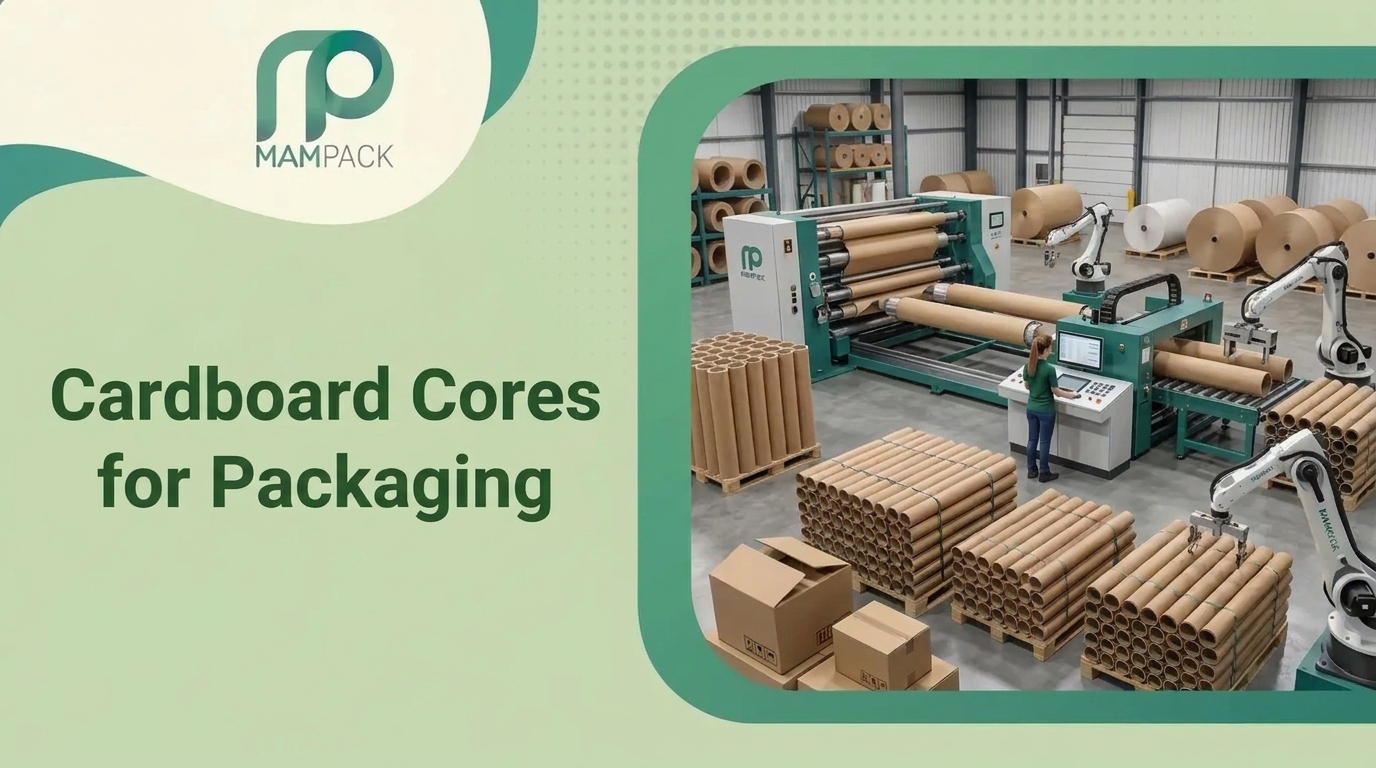
A roll of stretch film or printed laminate is only as stable as the tube inside it. If the core crushes, slips on the chuck, or swells in a humid warehouse, the roll is lost before it reaches your customer. Choosing cardboard cores for packaging comes down to a few numbers most buyers never put in writing. Do you know which ones your line depends on?
What Are Packaging Cores?
A packaging core is the paper tube a material is wound on. It gives the roll its shape, carries its weight, and connects it to the machine that winds or unwinds it.
On the factory floor you’ll hear them called cores, tubes, or packaging paper tubes. The name changes, but the job stays the same. Every core on a packaging line has three tasks:
- Keep the roll round from the first wrap to the last.
- Lock onto the shaft or chuck so the roll turns as one piece.
- Survive transport, stacking, and storage without flattening.
Most cardboard cores for packaging are made from layers of paper wound and glued into a rigid tube, then cut to length. What changes from one order to the next is the inside diameter, the wall thickness, and the paper grade. Those three choices decide whether paper cores for packaging industry applications hold up or fail halfway through a shift.
Which Packaging Materials Run on Cardboard Cores?
Each material stresses the core in its own way. Film pulls, laminates weigh, and labels demand precision. Know which one your line runs, and you know where the spec has to be strongest.
Stretch and Cling Film
Stretch film and cling film both run on cores, but they fail them in different ways: one through pressure, the other through slipping.
- Stretch film: wound under tension that keeps pressing on the core wall during storage.
- Risk of a thin wall: the core gives way slowly, and the roll turns oval on the pallet.
- Cling film: lighter rolls, but often run on fast rewinders.
- Risk of a loose fit: the core slips on the shaft and the winding goes uneven.
- Spec to prioritize: wall strength for stretch film, ID accuracy for cling film.
Flexible Packaging and Printed Film
Laminates and printed films come off the press in wide, heavy rolls, which puts flexible packaging cores under load and under watch at the same time.
- Roll weight: the core carries a heavy roll across a long length.
- Risk of bending: a weak core sags in the middle and ruins the roll shape.
- Press accuracy: any wobble shows up as print that drifts out of register.
- Spec to prioritize: straightness and anti-bow control, not thickness alone.
Tapes and Labels
Tape and label cores are short and made in large numbers, so the challenge here is keeping every piece the same.
- Cut quality: a core cut at an angle can stop a slitter or labeling head.
- ID tolerance: a core slightly off on size won’t sit right on the machine.
- Edges: square, clean edges matter more than a heavy wall.
- Further reading: our guide to cardboard cores for tape.
read more :Best Rotogravure Printing Company mampack
Which Core Size Does Your Machine Need?
Core size is set by your machine, not by preference. The shaft decides the inside diameter, and roll weight decides wall thickness. Here are the standard sizes MAMPACK makes and where each one fits on a packaging line:
| Core size | Typical use | What to check first |
| 2″ | Light, narrow rolls such as small tape and label rolls | The 50 mm ID against your actual shaft |
| 3″ | The most common size on packaging lines: stretch film, tape, printed film | ID tolerance and wall strength under winding tension |
| 6″ | Wide, heavy rolls of flexible packaging and printing material | Wall thickness against roll weight |
| 8″ | Large rolls on high-capacity converting lines | Straightness over the full length |
| Custom | Non-standard machines and special projects, up to 450 mm | A drawing with ID, wall, length, and tolerance |
Two Mistakes to Avoid When Ordering:
Most size problems don’t come from the table above. They come from two details buyers skip:
- Bigger rolls need more than a bigger diameter: flexible packaging cores in 6 and 8 inches are often long enough that bowing becomes the real risk, so ask for anti-bow control.
- Old orders aren’t measurements: measure the shaft on the actual machine before ordering cardboard cores for packaging. Copying a size from an old purchase order is how a whole pallet ends up spinning loose.
For a full breakdown of every standard size, see our guide to cardboard core sizes.
What Specs Should You Check Before Ordering Cores?

Three specs decide whether a core survives your line: flat crush, moisture, and inside diameter. Here’s what each one means and what to ask your supplier.
Flat Crush Resistance
Flat crush is the load a core wall can take before it collapses when pressed from the sides.
- When it matters: rolls wound under high tension or stacked high on pallets.
- Sign of a weak core: cores that flatten or turn oval after storage.
- What to ask: tested values on each batch, not a label like “heavy duty.”
Moisture Content
Paper takes moisture from the air, so a core’s condition changes with the room it’s stored in.
- Damp core: softens and swells, and may no longer slide onto the chuck.
- Strength loss: crush resistance drops right when the roll weight needs it most.
- Storage risk: packaging cores kept near an open loading bay in humid weather can behave very differently from the sample you approved.
- What to ask: how the cores are dried and how moisture is controlled before delivery.
ID Accuracy
Inside diameter is where the core meets your machine, so small errors show up fast.
- Too tight: operators fight to load the core.
- Too loose: the core spins on the shaft instead of turning with it.
- What to ask: the ID in millimeters, with the tolerance your machine can accept.
What to Put on Your Purchase Order
A clear order saves a second round of samples. Write these specs as numbers, not descriptions:
| Spec | How to write it |
| Inside diameter | In mm, with tolerance |
| Wall thickness | In mm |
| Length | In mm, with square cut ends |
| Roll weight and tension | Weight per roll, plus winding tension if known |
| Storage conditions | Dry warehouse or humid area |
read more :Custom Cling Film Cores for Converters
Why Choose MAMPACK for Cardboard Cores for Packaging?
MAMPACK has made paper tubes and industrial cores in Egypt since 2015, supplying paper cores for packaging industry lines that need the same core from the first pallet to the last.
- Custom cores up to 450 mm in diameter: a size no other manufacturer in the region makes.
- 1,000 tons per month of capacity: enough to keep supply steady through peak season.
- Standard sizes of 2, 3, 6, and 8 inches: ready for most packaging machines.
- Imported paper from global suppliers: stable quality from one batch to the next.
- Moisture control and proper drying: cores leave the factory ready for humid storage.
- Anti-bow control: long cores arrive straight and stay straight.
- Testing and quality follow-up: checks run during production, not only at the end.
- 100+ employees, technicians, and workers: a technical team behind every order.
Your roll is only as good as the core under it, and that core is only as good as the spec behind it. Send MAMPACK your shaft size, roll weight, and material, and Request a Quote for cardboard cores for packaging that fit your line on the first order, not the third.
FAQs
What size cores does the packaging industry use?
Most packaging lines run on 2, 3, 6, or 8-inch cores, and MAMPACK makes all four as standard sizes.
What are cardboard cores used for in packaging?
They give rolls of stretch film, flexible packaging, tape, and labels a rigid base to wind on, carry the roll’s weight, and connect it to the machine
How do I choose a packaging core?
Start from your machine’s shaft size, match the wall thickness to the roll weight, and ask for controlled moisture and a tight ID tolerance.
Are cardboard cores better than plastic cores for packaging?
For most packaging rolls, a cardboard core made to the right wall thickness and moisture level carries the load well and can be recycled with paper waste.
Can packaging cores be custom made?
Yes, MAMPACK makes custom cores to your drawing, up to 450 mm in diameter.