
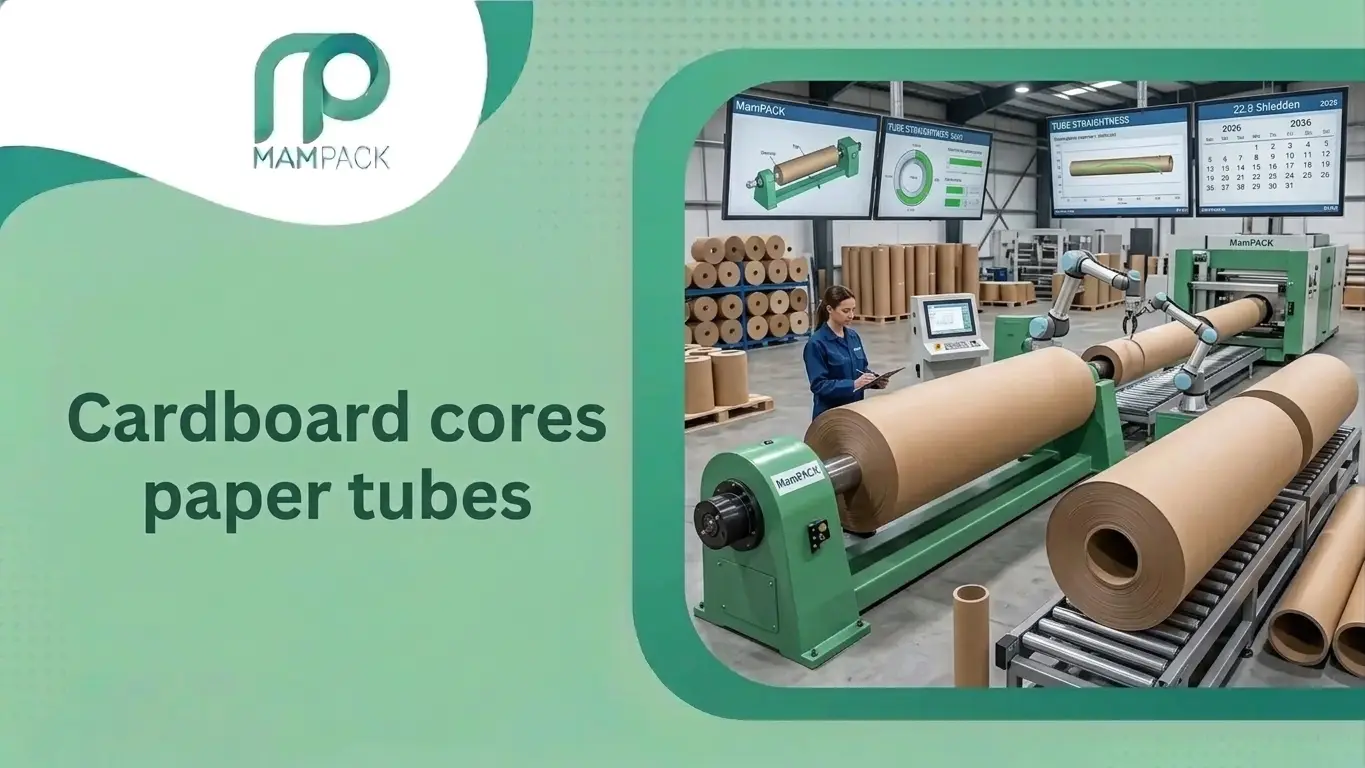
Most factories order cardboard cores paper tubes by size alone, then wonder why one batch runs clean and the next one bends. Size is the easy part. Wall strength, moisture, and roundness decide what happens on the line.
This guide covers sizes, specs, and how to judge a supplier before you send a purchase order. What keeps failing on your line?
What Are Cardboard Cores and Paper Tubes?
Same family, different jobs. Both are made from layers of paper wound and glued into a rigid tube. What changes is what you do with them.
- Core: sits inside a roll and carries it. Film, foil, fabric, paper, and tape are all wound around a core.
- Tube: used on its own as a body, a sleeve, or a protective package.
- Both come from the same production line, but the spec that matters is different for each.
Need cardboard cores paper tubes that fit your production? MAMPACK offers standard and custom sizes. Contact us to discuss your requirements.
How Paper Tubes Are Made (Spiral Winding Process)
Spiral winding is why a paper tube holds load far better than its weight suggests. The paper is not stacked, it is crossed.
- Paper strips are unwound from multiple reels at the same time.
- Adhesive is applied to each layer as it feeds in.
- Strips wrap at an angle around a steel mandrel, each layer crossing the one under it.
- Layers build the wall until the required thickness is reached.
- The tube is cut to length, then dried and checked for straightness.
That crossed structure is what gives industrial cardboard cores their crush resistance. It is also why wall thickness, not just diameter, is the number you should be writing on the order.
Key Differences Between Cores and Tubes
The difference shows up in how each one fails, not in how they look on the shelf. Here is the practical split.
| Criteria | Cardboard core | Paper tube |
| Main job | Carries a wound roll | Holds, protects, or forms a shape |
| Critical dimension | Inside diameter, it must fit the shaft | Outside diameter and finish |
| Main stress | Rotation, tension, roll weight | Static load, handling, impact |
| Fails when | It slips, bends, or goes soft | It dents, splits, or loses roundness |
| Typical buyer | Film, foil, textile, tape, paper mills | Packaging, printing, construction |
Choosing Cardboard Core Manufacturers with proven production capabilities ensures consistent dimensions, high crush strength, and customized paper cores that meet the specific requirements of packaging, printing, tape, film, insulation, and industrial applications.
Paper Core Sizes and What Each One Is Used For
Paper core sizes are named by inside diameter, because that is the part that meets the machine. MAMPACK produces standard sizes from 2 inches up to 8 inches, plus custom sizes on request.
Common Diameters
- 2 inch (50mm ID): the small end of the range. Common for narrow rolls such as tape, labels, and light films where the roll weight is low and the machine head is small.
- 3 inch: the workhorse size. Stretch film, aluminum foil, and most flexible packaging reels run on it, which is why it is the size most procurement teams reorder every month.
- 6 inch: for heavier reels. Wider film widths, textile beams, and paper reels where the roll weight would flex a smaller core.
- 8 inch: big reels, long runs. Used where roll diameter is large and any bow in the core would show up immediately in the wound roll.
The right size is the one measured off your machine shaft in millimeters, not the one written on a drawing from three years ago.
Large Diameter Paper Tubes (Up to 450mm)
Above 8 inches you are in custom territory, and most suppliers in the region stop there. MAMPACK manufactures large diameter paper tubes up to 450mm, which covers:
- Artificial grass rolls, where roll width and weight are both high.
- Wide-width nonwoven and geotextile production.
- Insulation and mineral wool winding.
- Machine builders who need a sleeve or body at a size no catalog carries.
This is where a local supplier saves you real time. Large diameter paper tubes are slow and expensive to import, and they arrive damaged more often than small ones.
Wall Thickness and Length Options
Diameter gets all the attention. Wall thickness is what actually decides whether the core survives the season.
- Wall thickness is built to the load your roll puts on it, specified in millimeters, not as “heavy duty.”
- Length is cut to your machine width, with square ends. A crooked cut makes the core sit at an angle and wobble.
- Combination matters: a long core with a thin wall will sag in the middle even if the diameter is perfect.
Tell your supplier the roll weight and the width. Those two numbers do more for your spec than any catalog page.
Choosing Best Large Diameter Cardboard Core Manufacturer mampack ensures high-strength, precision-engineered cores with customized diameters, lengths, and wall thicknesses for demanding packaging, printing, winding, and industrial applications.
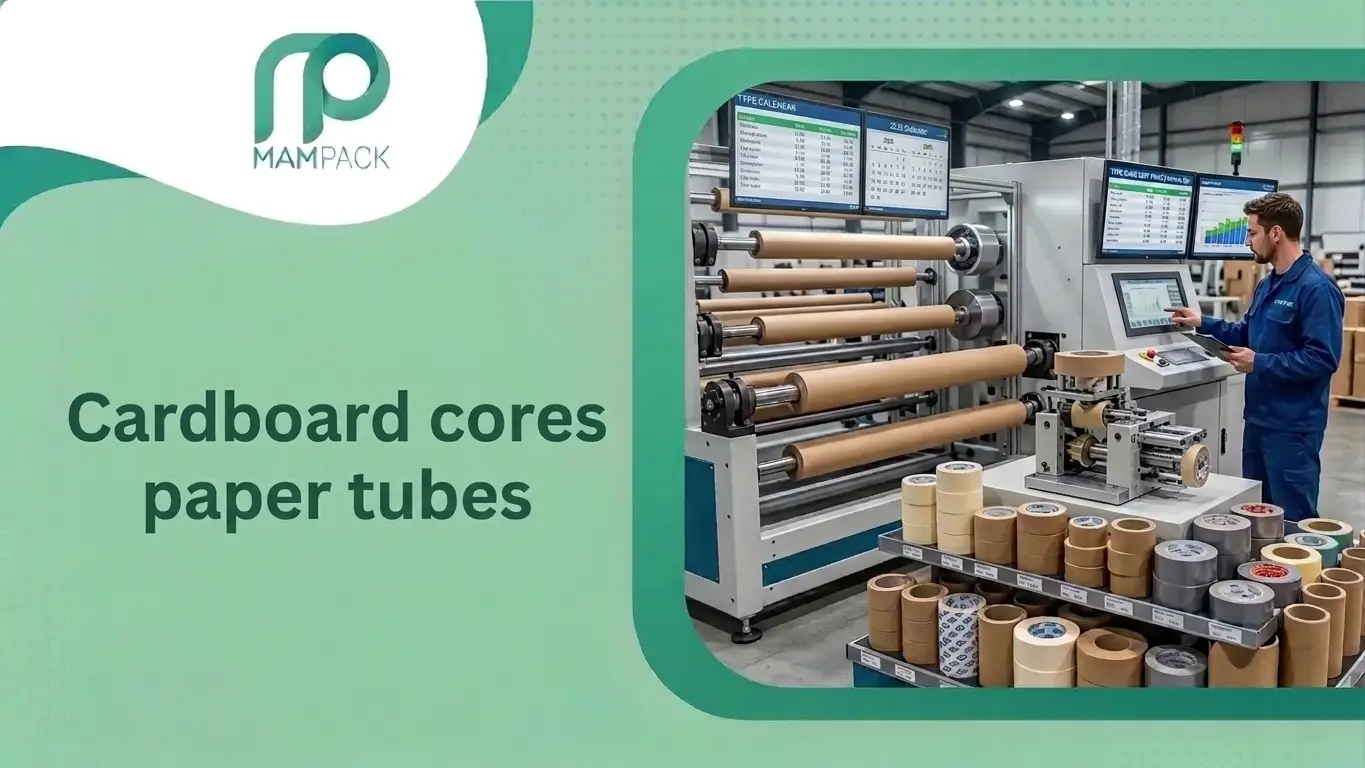
Industrial Applications of Cardboard Cores and Paper Tubes
One factory, several different jobs. Copying one spec across the whole order is the most common ordering mistake we see.
Cores for Produce Sorting Stations
- Sit in wet, humid rooms all shift, so moisture control comes first.
- Must hold the shaft tight or the roller spins free and fruit moves unevenly.
- Stiff wall required. Fruit load sits on the core continuously, not in bursts.
Tubes for Rotogravure Printing and Flexible Packaging
- Tight inside diameter tolerance. Printing heads reject anything slightly out of round.
- Consistent wall across the batch, because a single odd core stops the press.
- Clean, square edges so the reel starts straight and stays straight.
Cores for Insulation Material Winding
- Long lengths, light material, large diameters. Bowing is the main risk here.
- Anti-bow control and flat storage matter more than raw thickness.
- A core that sags ruins the roll shape before the material even ships.
Choosing the Best Cardboard Core Manufacturer for Citrus Sorting Stations mampack ensures precisely engineered cores with consistent dimensions, high strength, moisture resistance, and reliable performance for demanding citrus sorting and packing operations.
Key Specifications That Define Quality
These are the three numbers worth arguing about before you sign. Everything else is negotiable.
| Specification | What it tells you | What MAMPACK does |
| Flat crush strength | Whether the core holds its shape under real roll weight instead of collapsing at the ends | Cores built to the load of your application, with testing and quality follow-up during production, not only at the end |
| Moisture resistance | How the core behaves in a humid room. High moisture content means a soft core and a bent roll | Moisture control and correct drying before cores leave the factory |
| Diameter precision and roundness | Whether the core fits the shaft the same way every time, from the first piece to the last | High manufacturing accuracy on exact sizes, plus anti-bow control so what you ordered straight arrives straight |
Custom vs Standard Cardboard Cores Paper Tubes: Which Do You Need?
Not every order needs custom manufacturing, and paying for it when you do not need it is wasted budget. Here is the split.
When Standard Sizes Are Enough
- Your machines run on common paper core sizes and you have no plans to modify them.
- The roll weight is moderate and the room is dry.
- You reorder the same spec regularly and it performs.
- You need volume fast and the standard range covers it.
When to Request Custom Manufacturing
- Your machine was modified, imported, or built to order, so no catalog size fits.
- You need diameters above the standard range, up to 450mm.
- The core keeps failing and you need the wall or moisture spec changed.
- You want one supplier covering several lines instead of four different sources.
Custom paper cores are made to your inside diameter, wall thickness, and length. MAMPACK produces custom paper cores for local factories and export machinery using imported paper from global suppliers, which is what keeps quality stable between batches.
How to Choose the Right Paper Tube Manufacturer
Every supplier says their quality is high. Judge them on what they do before the order, not on what they promise after it.
Certifications and Quality Control
- Do they ask about your machine? Load, line speed, room humidity, or only size and quantity.
- Do they answer in numbers? Millimeters and moisture control, not “don’t worry, it’s strong.”
- Where does the paper come from? A clear answer means stable quality. A vague one means every batch is a surprise.
- Do they test during production? Checking at the end catches problems too late to fix.
- Will they send a trial batch? A technical paper tube manufacturer says yes without arguing.
Production Capacity and Lead Times
Capacity is not a vanity number. It is what decides whether you get supplied in peak season.
- Founded in 2015 in Egypt, specialized in paper tubes and industrial paper cores.
- More than 100 employees, technicians, and workers behind every order.
- 1,000 tons per month production capacity, with expansion in progress.
- Fast response on large orders in short lead times, which is the part that matters when your season starts.
- Local production means no import delay, no customs surprise, and a factory you can call in your own language.
A paper tube manufacturer sitting inside your market can adjust a spec in days. One sitting overseas will quote you a container and a six week wait.
Request a Quote or Place Your Order
Choosing between cardboard cores paper tubes suppliers comes down to one question: does this factory understand what happens to the core after it leaves their gate? Send MAMPACK your inside diameter, wall thickness, length, and roll weight, and you get a recommended spec and a trial batch instead of a price per piece.
Request a Quote with your sizes, or Place Your Order if your spec is already confirmed.
FAQs
What is the difference between a cardboard core and a paper tube?
A core sits inside a roll and carries it while it turns, so inside diameter is critical. A tube works on its own as a body or sleeve, so the outside finish matters more.
Can cardboard cores be custom manufactured?
Yes. Custom paper cores are made to your inside diameter, wall thickness, and length instead of a catalog size. This is the usual route for modified or imported machines.
What sizes do cardboard cores and paper tubes come in?
MAMPACK produces standard paper core sizes from 2 inches to 8 inches, with the 2 inch core at 50mm inside diameter. Large diameter paper tubes go up to 450mm on request.
Can cardboard cores be custom manufactured?
Yes. Custom paper cores are made to your inside diameter, wall thickness, and length instead of a catalog size. This is the usual route for modified or imported machines.
What industries use cardboard cores and paper tubes?
Stretch film, aluminum foil, artificial grass, flexible packaging, printing, textile, paper, and tape and labels. Each puts a different stress on the core.
How do I know if a paper tube is strong enough for my application?
Check flat crush strength, wall thickness, and moisture content. Give your supplier the roll weight and room conditions, then run a trial batch before the full order.